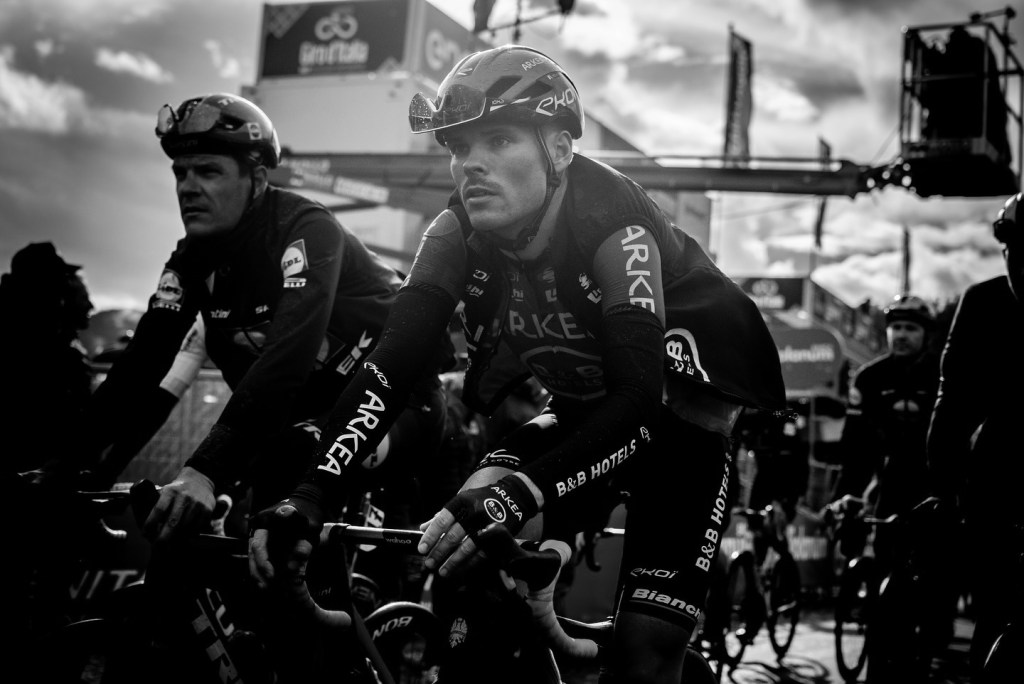
‘I managed to have less pain and I rode the stage at full speed as if I had escaped off the front. Except that I was actually behind the gruppetto’.
I’ve heard ‘poetry in motion’ used to describe Pogacar’s solo victory on the Mottolino on stage 15 of this years Giro d’Italia. This is an absolutely justified characterisation of his magnificent ride, made under a swaying canopy of Slovenian flags, dressed head to toe in pink. A majestic display that will undoubtedly adorn the history of the sport and etch a mark in the measuring stick for dominance and composure for years to come. Poetry indeed, but lovers of romance may wish to look deeper into the valley below to read a different type of verse, one which is not so prominently broadcast to the public. Many winding bends, banners, cheers, and faces down the mountain we can find riders on their absolute limit, experiencing levels of purgatory which seem a world away from the closed mouth, high-cadenced prowess of Tadej. Down here in the gruppetto, and the gruppetti of the gruppetto, we can gain a far deeper appreciation of the acts of self-flagellation that the workers of the peloton repeat day in and day out. Riders that win in impressive style deservedly cultivate such titles as ‘cycling hero’ . Heroism however, flows far more abundantly through the peloton than the cameras may show. My conversation with the Maglia Nera of the fastest Giro d’Italia on record has provided an intimate insight into the true grit and resolution present across the whole spectrum of riders in the peloton.
While Pogacar does what Pogacar does best at the top of the col, deep in the valley below a lone rider is in pursuit of the eviscerated peloton and subsequent subgroups fighting their way to the finish. Alan Riou, Breton, and winner of the 2021 Classique Loire Atlantique is riding his second Giro d’Italia for Team Arkea B & B Hotels. Now residing inland and away from his family and the rugged shores of his native Brittany, he misses the sea and lives a busy life balancing being a father to his young son and the demands of being a professional bike rider. His role for his team is a tough one, but one that he’s proud to do. There are no days off from caring for his teammates and if he is excused from his duty of riding in support of someone else it’s probably because he has a break to get into or a massive mountain to climb. On a typical day in the office Alan’s efforts will be utilised by the team in a variety of ways, but it all typically takes the form of riding really hard. He explained that,
‘On the sprint days I took care of our sprinters David and Jenthe. Especially in the final where my role was to place them in the best possible way in the last 20 km to prepare for the sprint. On days when a breakaway could go all the way, I took care of placing Ewen Costiou at the best he could, who was our best card for that.’
Stage 12 was certainly illustrative of the demands placed on riders either trying to form a break or assist their teammates in getting into them. The Arkea B & B Hotels boys could be seen floating around the front in ones and twos making sure to cover the seemingly endless escapes and recapture of break after break. It was a relentless struggle which indeed went on for over an hour of straight flat road, with dozens of riders trying again and again to get some organised group up the road. It wasn’t until Alaphillipe was able to exploit a small hump in the road that a breakaway was established, and Arkea B & B Hotels‘ presence in said move was no accident. This year’s giro was characterised by plenty of stages like this where the break took over an hour to escape and was in some cases caught early, meaning that racing resumed much earlier than anticipated. These tough stages, book ended with two hours of fast racing, undoubtedly contributed to the 2024 Giro being the fastest on record. Moreover, such days made life especially difficult for the likes of Alan and the peloton’s other diligent domestiques who were responsible for placing their ‘best card’ for a breakaway and then working to arrange the sprint only a couple of hours later. However, in the latter stages of the Giro Alan rolled the dice and tried on a few stages to get himself into the break.
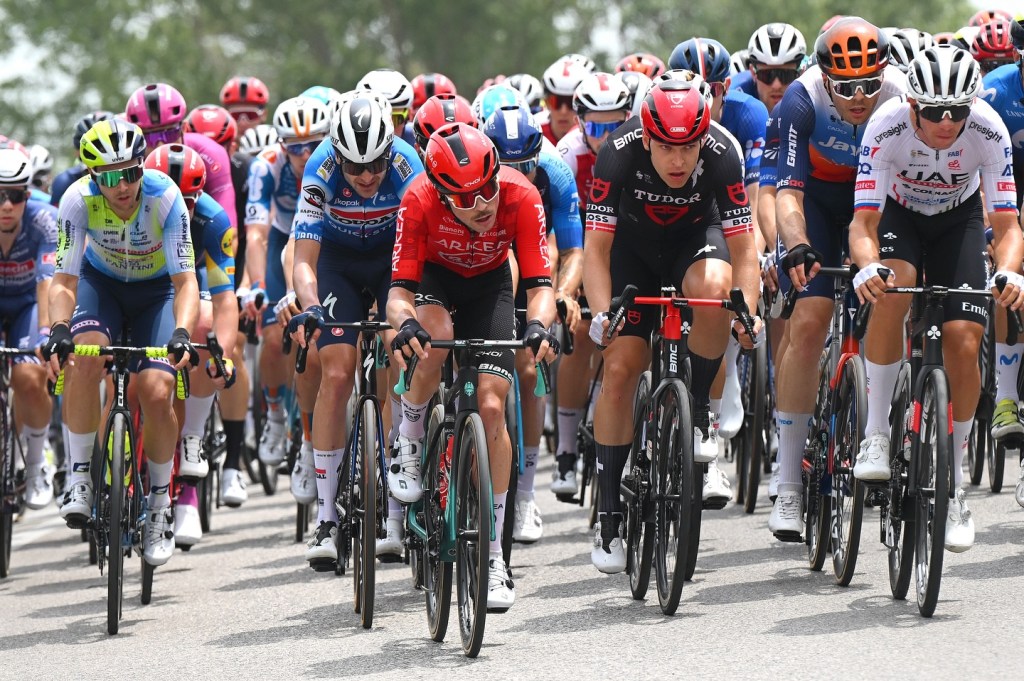
‘At the end of the Giro I tried on a few stages to make the breakaway because we had lost our sprinters. But either without success or it wasn’t a good idea because it was a very small breakaway of 3 or 4 riders who would have required a lot of energy for little chance of success and there were still big mountain stages to go through’.
This is something that we might overlook. Despite it being important for teams to get their jersey into the breakaway and onto our screens, sometimes the demands of riding hard off the front simply aren’t worth it when there are much harder days ahead. Alan had a slightly more flexible or self preservational role in the mountain stages;
‘In the high mountain stages, if there is a bit of flat before the first pass I could still help our climbers to position themselves so that they don’t make unnecessary effort at the foot of the pass. Then I hang on as much as possible and above all I try to be in a good group to reach the finish without problems with the deadlines. As long as I’m in the right day in terms of legs it’s quite simple. I climb well enough to be in the gruppetto easily’.
So often and especially in this current era of spectacular racing, our attention is focused on the battle at the front and if we are shown what’s going on in the gruppetto it will be because a big name is in difficulty. The reality however is that for so many riders, the hard attritional efforts of the gruppetto and the anxiety of the looming time cuts can be a daily routine in the mountains. For the famous sprinters, they will have a plan in place and their team will orientate their strategy around riding in the gruppetto, whilst handfuls of individuals find themselves amongst the sprint teams and may profit from their eagerness to keep up the pace.
‘For example, (Jonathan) Milan was surrounded by 2 or 3 teammates. Like Tim Merlier. It’s a bit like the gruppetto’s engines that guide the rhythm. The descents and valleys are done as quickly as possible […] while taking a look at the gap that separates us from the race to manage the deadlines’.
At the back of every mountain stage we can always find this special and familiar cohort of the peloton made up of regulars, part-timers, the wounded and the reluctant plus ones to the party. The sprinters know the drill and make sure to always have an entourage of thin-armed henchmen around them. The majority of the rest will be domestiques whose professional day is done and are on the long, grinding commute home. We all love the images of riders grabbing beers from spectators and pulling wheelies up the climbs to rapturous cheers from the roadside. If the peloton was a school bus, the gruppetto sometimes act like the naughty boys at the back, nonchalantly resting their feet on the seats and throwing paper planes. Indeed, the way riders can talk about the structure of a stage, the difference in pace between ‘the stars and the water carriers’ and the seemingly routine nature of the gruppetto can give a misleading impression that life in the back half of the race is cool and casual. This isn’t always true. We are often only afforded a very narrow and shiny glimpse of their day. So many factors go into what puts a rider in the grupetto and what makes their day-to-day, stage-to-stage endeavours all the more admirable.
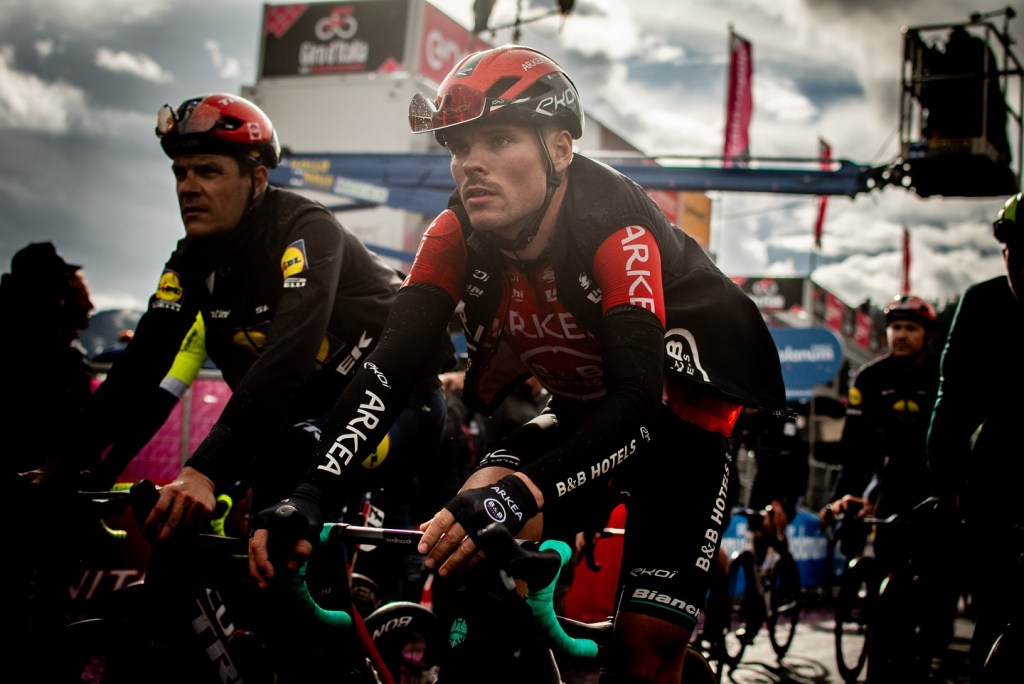
Alan suffered some hard crashes on the sprint stages, the injuries of which obviously didn’t help on the stages ahead. Remarking on his condition prior to stage 15, The Queen Stage, Alan remarked that,
‘It had been 2 days that I had pain in my buttocks due to a fall on stage 5 and then another fall on stage 13. The time trial (stage 14) didn’t help as we use the gluteal muscles a lot in the TT position. In my case, it was impossible to massage this area because I had a large wound and a hematoma’.
The demanding parcours partnered with his injuries served to make for a seriously grippy day out on the bike.
‘On The Queen Stage (15), I gave up on the second climb before the gruppetto had even been formed. I saw myself abandoned. I couldn’t force with the buttock and my left thigh was very painful.
In the end, once in the valley, I said to myself, “let’s try”. I knew that the delays were long, more than an hour given the length of the stage. Except that there was 60 km of valley to do alone between this second pass and the foot of the Mortirolo. I managed to have less pain and I rode the stage at full speed as if I had escaped off the front. Except that I was actually behind the gruppetto.
For the 60km of valley before the Mortirolo I did 40km alone before catching my teammate. I rode without asking him for a turn until the foot of the pass and in the meantime two riders who had been behind caught up to and joined us.
In the pass I waited for my teammate, I didn’t want to abandon him even though I could go up harder.
One of the other two riders left alone. But finally, after the descent of the Mortirolo into the valley of about 20 km, we caught him.
I rode alone with three riders in the wheel. My goal was to help my teammate to the foot of the last climbs by saving him as much as possible because he was in much greater difficulty than me at that moment of the race. As I had explained, I had dropped off on the second pass of the day because I couldn’t press the pedals. My hematoma and the muscle contracture in my buttocks were too painful. But afterwards, it was more bearable and in the end I had a good day in terms of my legs. I found strength.
So with this feeling, at the foot of the climb that brought us to Livigno I left them on my own. I gave everything I had. I had removed the earpiece, I knew where I was for the deadlines. Some directeur sportifs from other teams offered me a sticky bottle or two, but I had it in my head that I would only finish the stage with the strength of my legs and with my own abilities on the day. We’ll just see if I’m on schedule (to make the time cut). In the end, I made it‘.
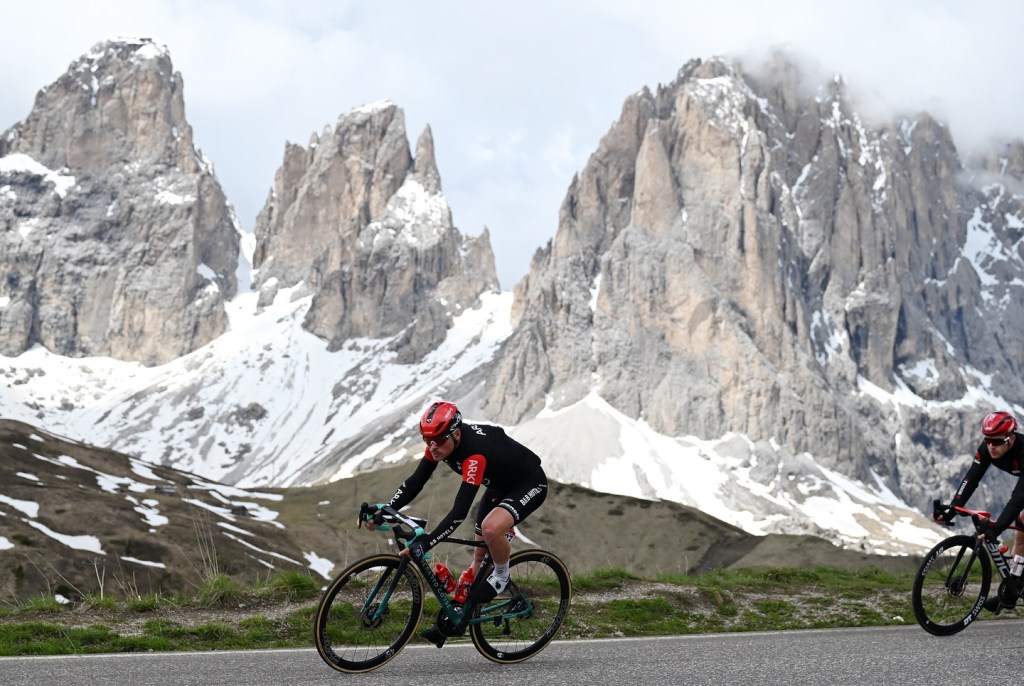
It was likely one of his hardest days on the bike. During this effort, Alan rode his personal best watts for 60 and 90 minutes. Rides like this could be dragged from some dusty archive of the old days. Although technology has improved to make riding faster, it doesn’t get any easier and these stories are testament to the mental fortitude of pro cyclists. In awe of such a ride, I asked him how they could prepare for such days. Days that can’t easily be simulated in training?
‘Well, we don’t necessarily prepare. We know it’s going to be tough. But for the time being, I didn’t think it would be so hard for me.
I didn’t expect to be so badly bothered by my crashes that day and suffer so much. So I think that after everything it’s done with the character we possess. I also had a motivation, which was that the next day was a rest day. And I said that there would be a way to regain my health, and I was right’.
No stranger to the adversity of the Giro Alan shared with me some other days that had required the same mental attitude in the 2023 Giro where he finished very ill and anaemic.
‘[…] In the 2023 there were some very hard stages with the very complicated weather. Like stage 14 where we started in + 20 degrees in Switzerland. After summiting the pass of the day we descended the other side in less than 5 degrees and rain until the finish. It was a fast descent and I was forced to stop halfway down and get help from the mechanic to change my clothes completely because I was shaking too much’.
I asked if after these kinds of days and with tough stages still lying ahead, carrying illness and injury, whether it’s something that he dwells on.
‘I basically like difficult conditions with the rain so it doesn’t cause me any problems. And if it does, I’m not really the type to question it.
I know that in cycling, the sensations of today day are not necessarily the sensations of tomorrow’
This last sentence absolutely epitomises the cyclist’s mentality. Watts, heart rate, and Training Stress Scores can only tell so much. Ultimately, it’s feeling that dictates. Sensation is the primary and purest of metrics that guide the cyclist. What is demonstrated plainly above is that the most inspiring riding of the day is not necessarily the guys we see duelling it out for victory and that so much heart and soul is poured out at all levels of the race. Tell me this isn’t “poetry in motion” too!
The legend of the long since abolished Maglia Nera has a certain following amongst some. However, it is not something that all riders will embrace so gladly. Understandably no one actually WANTS to be at the back and many guys sliding down into the Maglia Nera rather than comedically pursuing it like Mallabocca did so many years ago, wear the black jersey with some reservation. Although 148th of 148 in Rome, Alan was actually 148th of 176 who started in Venarea – Reale three weeks earlier. Every day that passes by and after every stage is completed the field of a grand tour will shrink a little bit. Someone who was comfortably five from the back might looked down to find that those riders have disappeared! This was the case for our Alan. Not for lack of trying to avoid last place he found himself there. What happened to those three riders he towed up the valley on the Queen Stage? Well, none of them made it to Rome. Alan said himself that he had tried to maintain a healthy gap from the very end of the GC rankings, but people kept abandoning behind him.
‘For my part, when I found myself last, I told myself that I would try to move up the rankings. Something I had been able to do by a few place, but those behind me gave up and I found myself last again’.
Alan sustained himself despite the challenges being sent his way and that’s what prompted our conversation. Understandable however, is that the attention the riders can receive for being the Lanterne Rouge or Maglia Nera cannot always be so welcome. As a reluctant custodian of the black jersey Alan made a valid point that had he come 142nd rather than 148th then no one would be talking to or interviewing him,
‘I know that it brings a little more visibility than if I had been just a few places before this last place. This was confirmed with more requests. While I had achieved nothing personally on the Giro. […] In the last week, I gave up the idea of taking back a few places. I was very good in the gruppetto. […] I suffered 2 crashes that made me lose time on bunch sprint stages. But I worked a lot for my team so once the work was finished I just got up (the mountains) to recover for the rest of the days. But it bothered me a little that people were talking about me just for this last place. I would have preferred to have done something in the Giro like a great breakaway in addition to being last’.
It’s sadly true that without Alan being last on GC our interview wouldn’t have happened. However his experience, the crashes, his solo pursuit of the gruppetto, the days of selfless efforts to assist his team would have all still happened, Maglia Nera or no Maglia Nera. Moreover, the same would be true for numerous other riders a few places above Alan or those that sadly had to abandon. They likely wouldn’t get to share their story either. These guys at the back riding their own race, facing their own trials and tribulations and who, barring the sprinters, are doing this in servitude of others deserve representation.
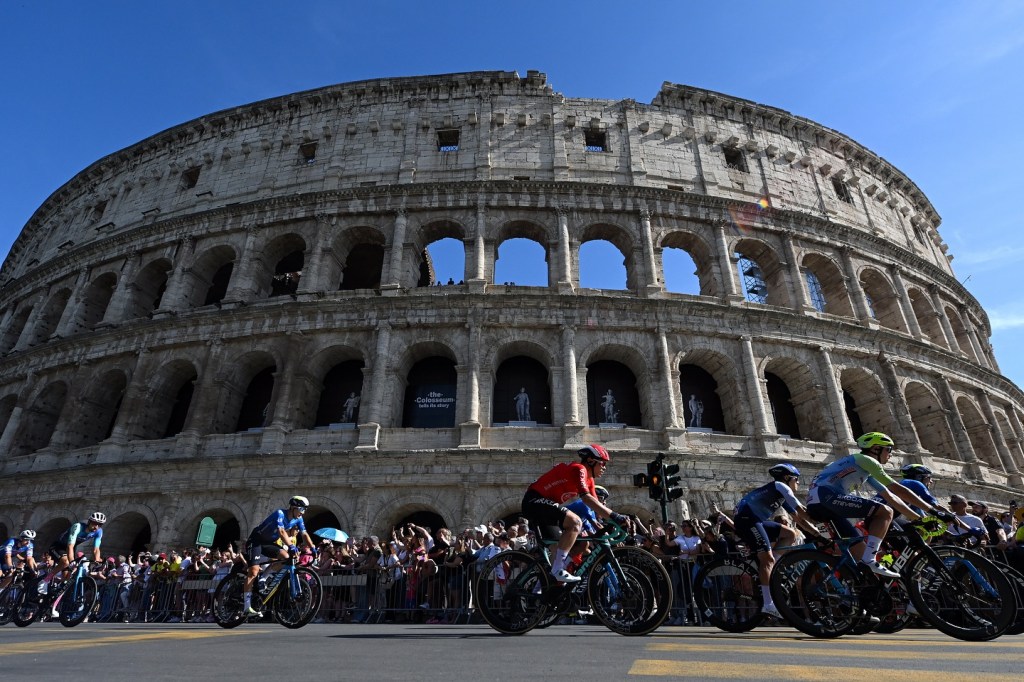
Someone has to be the flag bearer for these everyday warriors who are etching equally beautiful poetry for this sport’s lengthy verse. Why not the guy at the back? The first of the survivors. While the Maglia Rosa represents only one person, Pogacar is not carrying the standard on behalf of all the fast lads, the Maglia Nera is far larger than one man. The wearer of the sadly transparent Maglia Nera is the selected representative of the humble, silent, selfless and criminally overlooked majority of riders. Heroes who waste themselves day in day out to set the latter game of chess in motion. Although, unlike sacrificial pawns these guys aren’t cast from the board once they’ve swung off the front and out of site of the cameras. They very often still have hours left to ride and mountains still to climb.
To say that Alan didn’t achieve anything personally in the Giro is frankly bullsh*t. He served his team diligently and survived the race himself despite injury. It’s easy for riders to be disparaging of their own achievements but when they’re viewed in context and relativised by us mortals the immensity of it is patent. In the end, he talked himself round to this and at least acknowledged that he’s ‘proud to have made it to Rome with my abilities of the moment’.
Following the Giro he took time with his family, tended to the garden, and enjoyed some afternoon naps and a couple of steady rides on the mountain bike (whatever one of those is?). After being so ill after the 2023 Giro he’s looking forward to seeing how three weeks of hard racing will be absorbed by the legs and what form may come after.
What’s written above is not meant to be some kind of sycophantic love letter to one rider but more something to prompt us all to appreciate what happens just on the periphery of the main stage entertainment that the celebrities of the sport provide. Maybe next time you’re out fantasising about being a pro whilst swinging your bike up your most hated local climb, don’t seek inspiration by imagining you’re a Pogacar annihilating the field. Maybe imagine you’re a Riou, riding a 90-minute power PB chasing after the Gruppetto. Both rides are equally impressive in their own way. But if you love this sport like I do, I know which one you’ll find most inspiring.
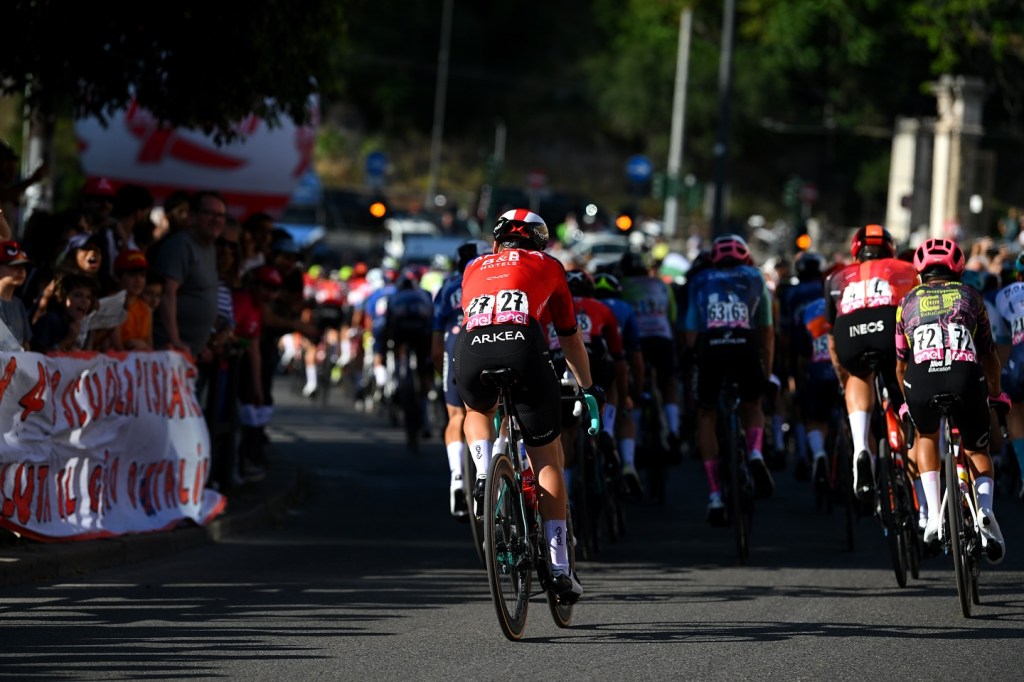
Merci Alan. Votre temps et votre franchise sont grandement appréciés et nous vous souhaitons la meilleure des chances pour le reste de la saison!
 Maglia Nera